// Synth Buyer's Guide
Find your first
hardware synth.
Answer 10 questions — get a personalised checklist and synths that match your exact requirements.
0 / 10
01 / 10
What's your budget?
Set a ceiling before browsing. Include cables and an audio interface if you need one.
02 / 10
Analog, digital, or hybrid?
Analog uses real electrical circuits — warm, organic. Digital is precise and stable with a wider palette. Hybrid combines analog signal path with digital oscillators or processing.
03 / 10
Normal synth or semi-modular?
Normal synths are fully wired internally — plug in and play. Semi-modular synths have patch points where you rewire signal flow with cables, like a mini modular system.
04 / 10
Built-in effects?
Reverb, delay, chorus on board means plug in and sound complete. No effects means a dry, raw signal — you add processing in your DAW or outboard gear.
05 / 10
Built-in keyboard or desktop module?
Keyboard synths are self-contained — play straight away. Desktop modules have no keys — connect an external MIDI keyboard to play them.
06 / 10
Arpeggiator and / or sequencer?
An ARP auto-plays held notes in repeating patterns. A sequencer lets you program your own step-by-step melodic patterns. Both help you make music without a DAW.
07 / 10
Screen or no screen?
A display shows parameter values, patch names, waveforms — very helpful for learning. Screenless synths are fully hands-on with one knob per function.
08 / 10
Presets or start from scratch?
Presets are factory sounds — switch them instantly and play right away. Without presets you design every sound from zero, which teaches synthesis much faster.
09 / 10
Are chords important to you?
Mono plays one note at a time — classic for bass and leads. Paraphonic plays multiple notes through a shared filter. Polyphonic gives every note its own independent voice — full chords.
10 / 10
Do you want aftertouch?
Aftertouch = press harder on a held key to modulate vibrato, filter, or volume. Mono aftertouch affects all held keys equally. Poly aftertouch tracks each key independently — very expressive, rare and expensive.
// Your results
Your synth checklist.
Your top 3 matches — mismatches are highlighted on each card.
// Synths that match your requirements
// Not ready to buy hardware yet?
Try thirty of them in your DAW first.
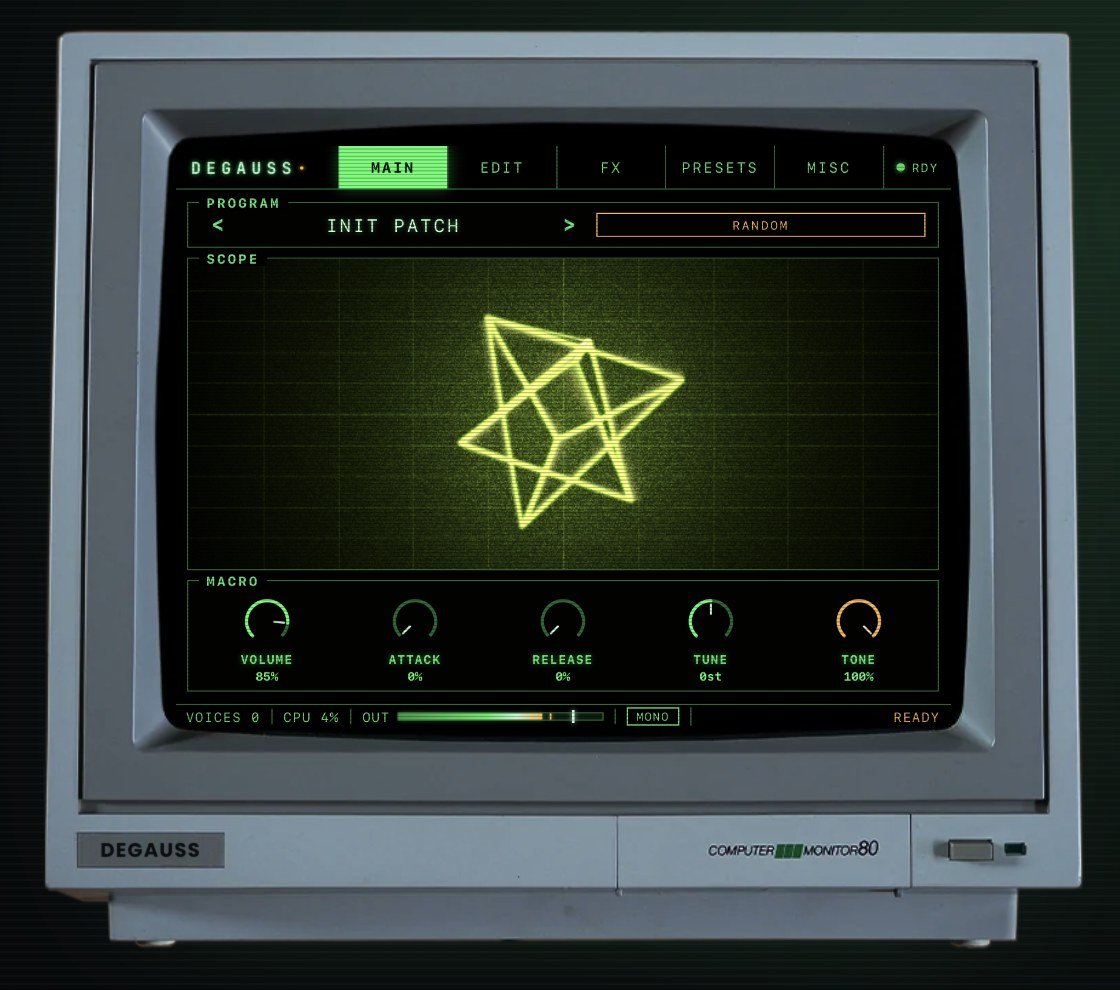
Degauss is my sampler plugin built from thirty rare vintage synthesizers — CS-80, Jupiter 8, OB-X, Memorymoog, Prophet 5 and more — sampled from the real machines. You get the sound of the gear on this list (and a few you’ll never afford) for a fraction of anything on this list, while you decide which hardware to buy.
See & hear Degauss →