Course Content
2. Connections
In this chapter, we focus on the connection options of the Poly D. You’ll learn how to use the audio, MIDI, CV, and USB connections, and how they allow the synth to communicate with other instruments, controllers, and recording setups. This lesson will help you integrate the Poly D smoothly into your studio or live performance workflow.
0/5
3. Initializing & Tuning
In this lesson, you’ll learn how to initialize the Poly D to a basic starting sound and properly tune the instrument. We cover oscillator tuning, calibration considerations, and best practices to ensure the synth is stable, in tune, and ready for sound design or performance.
0/3
4. Modules
In this lesson, we explore the different modules of the Poly D. You’ll learn the functions of each section, including oscillators, filters, envelopes, LFOs, and mixers, and how they interact to shape the overall sound. Understanding the modules is key to mastering synthesis on the Poly D.
0/14
5. Sequencer & Arpeggiator
In this lesson, we dive into the Poly D’s sequencer and arpeggiator. You’ll learn how to create patterns, program sequences, and use the arpeggiator to generate rhythmic note patterns. Understanding these tools allows you to add movement, complexity, and creative performance possibilities to your patches.
0/7
6. Sound Design
In this lesson, we break down typical sound categories on the Poly D, including plucks, basses, leads, and chords, while exploring 50 presets that showcase classic analog sound design techniques. Starting with simple patches, we gradually introduce advanced methods such as modulation, layering, and processing, giving you the tools to create rich, expressive, and professional-quality sounds from scratch.
0/6
Behringer Poly D Course

In this introductory lesson, we take a guided tour of the Behringer Poly D and outline how the course is structured, giving you a clear roadmap for what you’ll learn and how everything connects.


You’ll learn how to:

  • Understand the overall layout and signal flow of the Poly D
  • Identify the role of oscillators, mixer, filter, envelopes, and modulation
  • Recognize how paraphony works and how it differs from true polyphony
  • Navigate modulation sources like LFOs and envelopes
  • See how effects, the sequencer, and the arpeggiator fit into the synthesis chain


This lesson sets the foundation for everything that follows. By understanding how each section functions on its own—and how they work together—you’ll be prepared to move confidently into deeper sound design, advanced techniques, and creative workflows throughout the course.

Exercise Files
Poly D Manual.pdf
Size: 5.58 MB
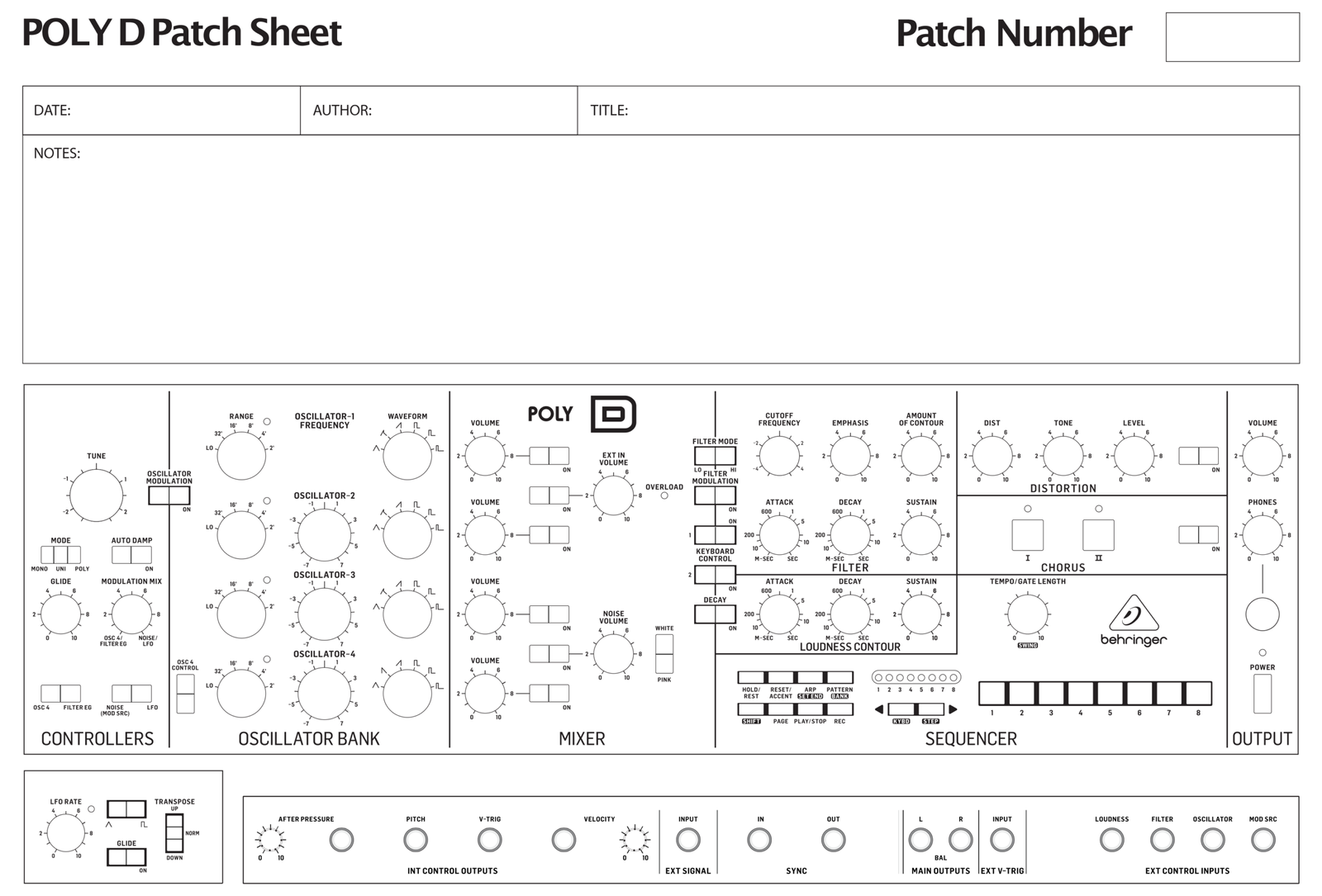
PolyD_Blank-Patch.png
Size: 592.32 KB
Cool Stuff for the Poly D.pdf
Size: 15.74 KB
0% Complete